What’s the role of the G7 in a G-Zero world?
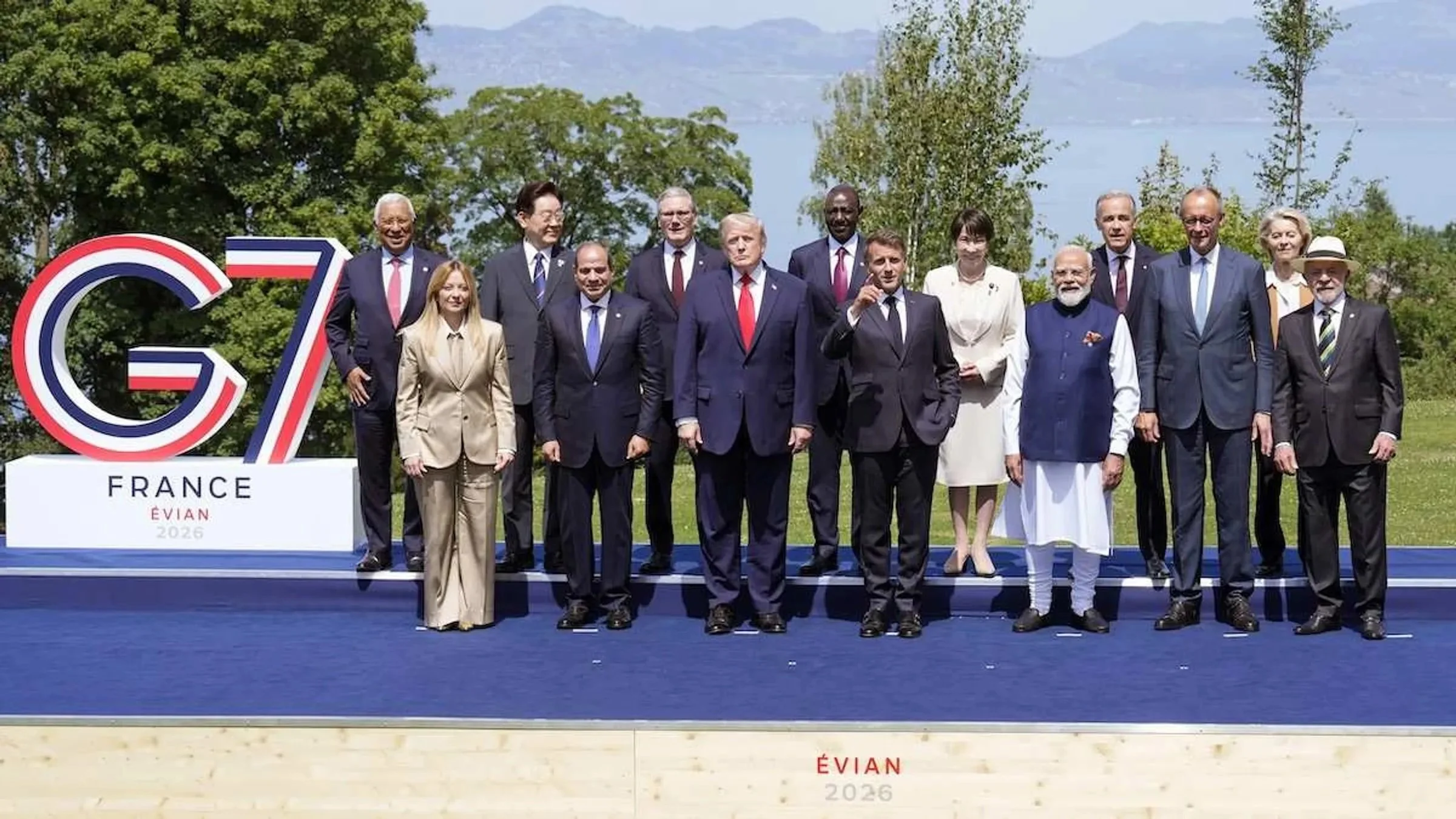
Leaders of each country including (front from left) Italian Prime Minister Giorgia Meloni, Egyptian President Abdel Fattah el-Sisi, US President Donald Trump, French President Emmanuel Macron, Indian President Narendra Modi, Chancellor of Germany Friedrich Merz, Brazilian President Luiz Inácio Lula da Silva, (rear from left) President of the European Council António Costa, Korean President Lee Jae Myung, UK Prime Minister Keir Starmer, Kenyan President William Ruto, Japanese Prime Minister Sanae Takaichi, Canadian Prime Minister Mark Carney and President of the European Commission Ursula von der Leyen pose for a family photo at the G7 summit in Évian, France, on June 16, 2026. Credit: The Yomiuri Shimbun
Leaders of the G7 are meeting this week in Évian-les-Bains, France, for their 52nd official summit. When the forum was created in 1975, amid the collapse of the Bretton Woods monetary system and oil shocks of the 1970s, it brought together the world’s industrial democracies to manage global crises. Over the following decades, it helped coordinate responses to challenges like the end of the Cold War, terrorism, climate change, the COVID-19 pandemic, and the war in Ukraine.
But the international community looks very different today. In 2026, the G7 finds itself operating in a “G-Zero” world – with no clear leader. The United States has retreated from its role as global policeman, instead pursuing an “America first” agenda that has isolated itself from its allies. At times, the group can seem less like a G7 and more like a G6+1. Read More